Across South Kolkata, communities are facing a troubling surge in depression, driven by a mix of social and economic pressures. One of the most significant factors is the slowdown in the job market, which has left many struggling to maintain stability and quality of life. This economic strain often translates into stress, anxiety, and a sense of hopelessness, making the need for reliable depression treatment in South Kolkata more urgent than ever.
Another powerful influence is the dominance of social media. While it connects people virtually, it has also fostered isolation, with many individuals feeling detached from genuine, face-to-face relationships. This disconnection deepens loneliness and fuels despair, compounding the mental health crisis.
Of course, these are only part of a larger, more complex picture. The rise in depression has tragically contributed to increasing suicide rates, underscoring the seriousness of the issue. In response, rehabilitation centres have become vital lifelines, offering structured care and emotional support.
At We Can Rehab, we are at the forefront of this effort. Our team provides compassionate, professional treatment designed to help individuals confront the challenges of depression, uncover its root causes, and build healthier coping strategies. More than just a treatment facility, we serve as a source of hope, empowering people to move toward recovery, resilience, and renewed well-being.
Why Depression is a Threat to the Indian Population
India’s mental health landscape has been under strain for years, and the findings of the National Mental Health Survey (2015–16) already pointed to worrying trends. The COVID-19 pandemic intensified these challenges dramatically, such as social isolation, financial instability, and widespread fear of infection. All of which contributed to a sharp rise in depression. According to the World Health Organization (WHO), depression now accounts for a major portion of the country’s overall mental health burden. Several interconnected pressures are fueling this escalation:
- Academic stress: Teenagers face immense pressure to perform, often leading to anxiety and depressive symptoms.
- Job insecurity: Young adults struggle with unstable employment, creating deep uncertainty about their future.
- Social isolation: Both men and women increasingly report loneliness, worsened by shrinking community ties and digital dependence.
- Lifestyle pressures: The push to maintain unsustainable standards of living has driven many into debt, compounding emotional strain.
Together, these factors create a cycle of overwhelm that pushes individuals deeper into depressive states. This makes the role of dedicated treatment centres and community-based support systems more critical than ever, especially in regions like South Kolkata, where economic and social pressures are strongly felt.
Explore the Prevalence of Depression in Indians
| Sociodemographic characteristics | Prevalence of Depressive Disorders | ||
| Current % (95% CI) | Lifetime % (95% CI) | ||
| Total | 2.68 (2.65 to 2.71) | 5.25 (5.21 to 5.29) | |
| Residence | Rural | 2.15 (2.12 to 2.18) | 4.48 (4.42 to 4.51) |
| Cities with population <1 million | 1.90 (1.84 to 1.96) | 4.93 (4.82 to 5.01) | |
| Cities with population >1 million | 5.17 (5.08 to 5.25) | 8.23 (8.11 to 8.33) | |
| Education | Illiterate (no formal education) | 3.63 (3.57 to 3.70) | 6.04 (5.95 to 6.11) |
| Primary (first to fifth std) | 3.11 (3.04 to 3.18) | 5.76 (5.67 to 5.85) | |
| Secondary (sixth to seventh std) | 2.70 (2.63 to 2.77) | 5.86 (5.76 to 5.96) | |
| High school (eighth to tenth std) | 2.26 (2.20 to 2.33) | 4.67 (4.57 to 4.76) | |
| Pre-University/Vocational | 1.61 (1.54 to 1.68) | 3.20 (3.11 to 3.29) | |
| Graduate/Postgraduate/Professional | 1.37 (1.30 to 1.42) | 4.49 (4.38 to 4.59) | |
| Occupation | Working | 2.70 (2.66 to 2.74) | 5.56 (5.50 to 5.61) |
| Not working | 2.66 (2.62 to 2.70) | 5.00 (4.95 to 5.05) | |
| Marital Status | Never married | 1.70 (1.65 to 1.75) | 2.87 (2.80 to 2.93) |
| Married | 2.75 (2.72 to 2.79) | 5.44 (5.39 to 5.48) | |
| Widowed/Divorced/ Separated | 5.23 (5.06 to 5.39) | 11.23 (10.98 to 11.45) | |
| Income quintile | Lowest | 3.42 (3.35 to 3.50) | 6.36 (6.25 to 6.45) |
| Second | 3.14 (3.07 to 3.21) | 5.68 (5.58 to 5.77) | |
| Middle | 2.89 (2.82 to 2.95) | 5.42 (5.32 to 5.50) | |
| Fourth | 2.20 (2.14 to 2.26) | 4.21 (4.13 to 4.29) | |
| Highest | 1.91 (1.86 to 1.96) | 4.76 (4.68 to 4.84) | |
The Need for Depression Treatment in South Kolkata to Prevent Suicide
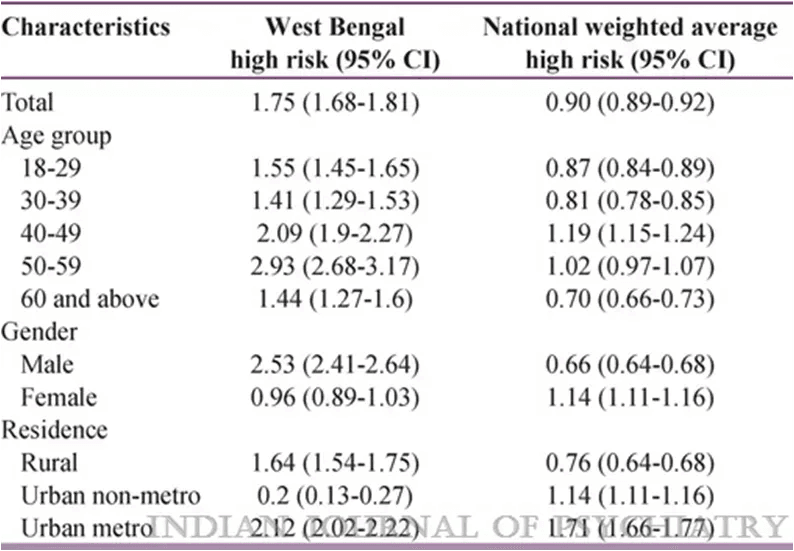
According to findings from the National Mental Health Survey of India, as published in the Indian Journal of Psychiatry (2023). Our state has a much higher rate of mental health disorders, around 13.07%, compared to the national average of 10.6%. Looking more closely at the data, conditions like schizophrenia, psychotic disorders, mood disorders, and stress-related problems are noticeably more common here than in other parts of the country.
A troubling trend in West Bengal is the rising suicide risk, especially among men in their 40s and 50s. Urban living seems to be a major factor driving this issue, pointing to the urgent need for targeted, community-focused mental health support in the region.
What to Expect from Depression Treatment in South Kolkata
Picking a leading depression rehab centre in West Bengal means trusting skilled professionals dedicated to helping people heal. The place should feel calm and welcoming, giving individuals a sense of safety and care from the moment they walk in. Every staff member contributes to building a warm, supportive space that encourages emotional recovery.
The centre needs to understand that everyone’s challenges are different, calling for personalised solutions instead of a one-size-fits-all approach. To get a clearer picture of how these centres work, here’s a quick look at the key steps in effective rehabilitation:
| Steps | Process |
|---|---|
| Step 1 | Assessment and Diagnosis |
| Step 2: Detoxification (If Necessary) | 1. Safe management of withdrawal symptoms 2. Stabilisation and preparation for therapy |
| Step 3: Individual Therapy | 1. Cognitive-behavioural therapy (CBT) 2. Psychodynamic therapy 3. Interpersonal therapy (IPT) 4. Mindfulness-based cognitive therapy (MBCT) |
| Step 4: Group Therapy | 1. Supportive group therapy 2. Skills development groups (e.g., coping skills, stress management) 3. Educational groups (e.g., depression management, mental health education) |
| Step 5: Medication Management | 1. Antidepressant medication management 2. Regular monitoring and adjustment of medication 3. Education on medication and potential side effects |
| Step 6: Alternative Therapies | 1. Art therapy 2. Music therapy 2. Yoga and mindfulness therapy 4. Acupuncture |
| Step 7: Family Therapy | 1. Education on depression and its impact on the family 2. Communication skills development 3. Family support and counselling |
| Step 8: Lifestyle Changes | 1. Healthy sleep habits development 2. Regular exercise and physical activity 3. A balanced diet and nutrition education 4. Stress management techniques |
| Step 9: Relapse Prevention | 1. Identification of early warning signs 2. Development of coping skills and strategies 3. Relapse prevention planning |
| Step 10: Aftercare Planning | 1. Discharge planning and preparation 2. Follow-up appointments and therapy sessions 3. Connection with community resources and support groups |
How We Can Rehab Offers the Best Depression Treatment in South Kolkata
At We Can Rehab, we are deeply committed to addressing the growing challenge of depression in South Kolkata with a structured, compassionate approach. Our treatment program begins with open, empathetic conversations that allow individuals to share their struggles in a safe environment. From there, we guide them into a carefully designed rehabilitation process, ensuring continuity of care at every stage.
Recognising that no two journeys are alike, we avoid one-size-fits-all solutions. Instead, our team develops personalised recovery plans that reflect each person’s unique circumstances. By collaborating with leading mental health professionals, we craft strategies that address both immediate symptoms and deeper, underlying causes. We blend diverse treatment modalities to promote complete healing:
- Herbal remedies for natural support
- Medication-assisted therapy when clinically necessary
- Group therapy to foster community and shared strength
- One-on-one counselling for individualised guidance
- Meditation and mindfulness to restore inner balance
- Exercise therapy to enhance physical and mental resilience
- Nutritional counselling to support overall wellness
Recovery doesn’t stop when treatment ends. That’s why we emphasise long-term support, offering access to peer groups, ongoing counselling, and resources that help individuals sustain progress. At We Can Rehab, we believe that with the right care and community, anyone can reclaim balance, resilience, and a fulfilling life.
Conclusion
Whether it’s you or someone you care about, facing depression and fighting off suicidal thoughts is never easy. In these times, what matters most is having steady support, someone who’s there through every step of the journey. At We Can Rehab, we’re dedicated to being that support system. Everything we do is driven by the belief that every life is precious and should never be lost to a mental health struggle. This steadfast commitment is what makes our offering of depression treatment in South Kolkata.
FAQs
- Is treatment personalised for each patient?
- Each person gets a personalised treatment plan tailored to their emotional, psychological, and physical health needs. We steer clear of one-size-fits-all methods and prioritise lasting recovery.
- Does We Can Rehab provide aftercare or long-term support?
- Yes, we do. After treatment, care involves regular check-ins, peer support groups, lifestyle coaching, and access to helpful resources to support progress and prevent relapse.